
Mighty Mule Gate Repair in Chesapeake: A Homeowner’s Guide
Mighty Mule builds openers for homeowners who want to install a gate operator themselves, and that’s exactly why so many Mighty Mule systems in Chesapeake develop problems a few seasons in. The opener itself is usually fine. The installation around it isn’t. In our experience, most residential Mighty Mule installs we’re called out to have at least one deviation from the manufacturer’s spec, and the homeowner has no idea it’s there. If you’d rather not sort through it yourself, call (833) 323-1302 and we’ll take a look.
Key Takeaways
- Mighty Mule openers are designed for DIY installation, which makes them the brand most likely to arrive with setup-related faults.
- Misaligned travel limits and undersized solar panels are the two failure modes we see most often.
- An opener that’s the wrong size for the gate will keep failing no matter how many parts get replaced.
- Some Mighty Mule components can be sourced locally; others need to be ordered, and turnaround affects your repair timeline.
Which Mighty Mule models do Chesapeake homeowners actually have?
The two units we’re called out to most in Chesapeake are the FM500 and the MM571W, and each has its own pattern of trouble.
The FM500 is a swing opener, and its weak point is the control board’s sensitivity to voltage sag. When the battery isn’t holding a full charge, the board doesn’t fail cleanly. It starts behaving unpredictably: the gate opens partway and stops, the arm reverses for no reason, or the remote works sometimes and not others. Homeowners usually assume the remote or the receiver has gone bad and buy a replacement that doesn’t fix anything. The battery and the charging circuit are the real suspects.
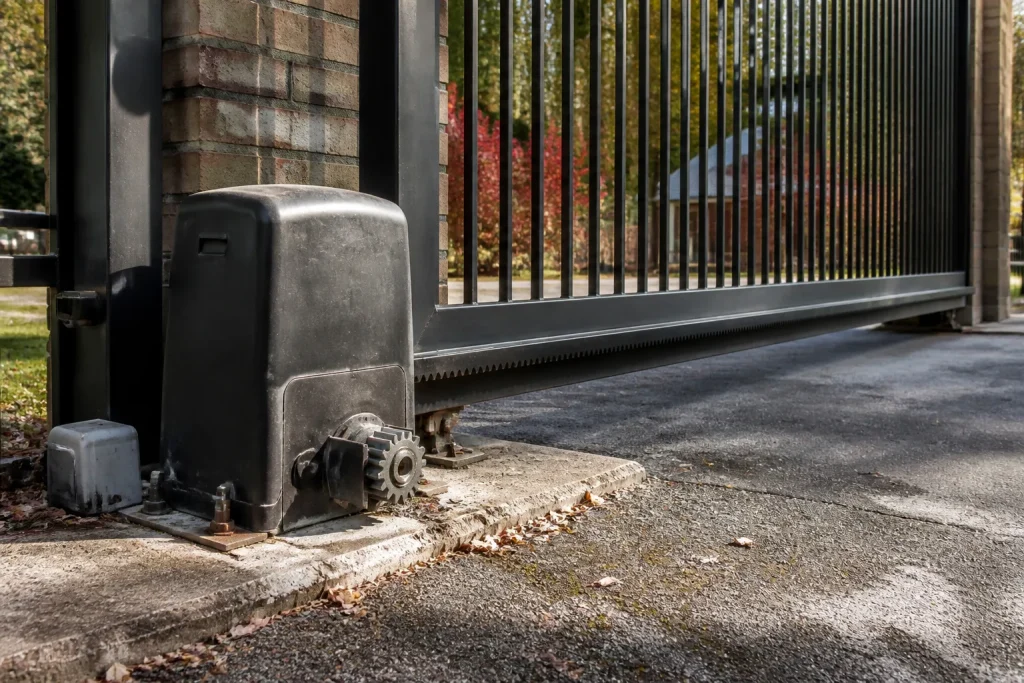
The MM571W is a slide unit, and it’s the one we see cycling its battery to death. A slide gate has more rolling resistance than a swing gate, especially if the track has debris or the wheels have flattened, and that extra drag pulls more current on every cycle. Add a solar panel that’s too small to keep up and the battery spends its life in a partial state of charge. That shortens battery life dramatically and produces the “works fine in the morning, dead by afternoon” complaint.
Other Mighty Mule models turn up around Chesapeake too, and the diagnosis follows the same logic: what’s the gate asking of the opener, and is the power supply keeping up with it? We work on the brand you already have, and Mighty Mule is one of nine we’re trained on, alongside LiftMaster, FAAC, BFT, Linear, Viking, Ghost Controls, DoorKing, and Elite.
How do you set travel limits on a Mighty Mule opener, and why does it matter?
Travel limits tell the opener exactly where the gate should stop in the open and closed positions. Set them wrong, and the motor keeps pushing against a physical stop on every single cycle. That’s the step most DIY installers skip or rush, and it’s the number one cause of motor burnout on Mighty Mule units.
The correct sequence, in general terms, looks like this:
- Disconnect the operator arm or release the slide clutch so the gate moves freely by hand.
- Check the gate’s mechanical travel – it should open fully without hitting a post, fence, or the ground, and close flush without binding.
- Set the open limit first, with a small buffer before the physical stop so the motor isn’t loaded at the end of travel.
- Set the close limit the same way, leaving a gap that lets the gate seal without pressing hard.
- Run the gate through several full cycles and watch and listen. A correctly limited gate coasts to a stop. A mislimited one strains, clunks, or reverses.
The specifics vary by model, and Mighty Mule’s manual is the authority for your unit. What we’d flag is this: limit switches that are set right but mounted loosely will drift out of adjustment over months of vibration. If your limits keep needing re-set, the mounting is the problem, not the setting.
Is the included solar panel enough for a Chesapeake gate?
Usually not, and Chesapeake’s winters make it worse. Mighty Mule kits typically ship with a small panel sized for a best-case scenario: full sun, moderate gate weight, modest daily cycles. Chesapeake gets a lot of partly cloudy days through the colder months, and a panel that produces enough on a clear summer afternoon may only deliver a fraction of that under grey winter skies.
Here’s the reality check. A solar panel needs to replace, on an average day, everything the opener used. If your gate cycles ten times a day, the opener draws a measurable amount each cycle, and the panel’s realistic output in winter is a fraction of its rated number, the math stops working. You don’t need to calculate it to the watt. You need to notice the symptoms:
- The gate slows down noticeably on overcast stretches.
- The battery reads low after two or three cloudy days in a row.
- The opener works in the afternoon and fails in the morning.
- You’re replacing the battery more often than seems reasonable.
Any of those means the panel is undersized for your gate’s real workload in Chesapeake. The fix is either a larger panel, a second panel, or moving the existing one to a spot that gets more direct light. A technician can measure actual draw and match the panel to it rather than guessing.
When is a Mighty Mule the right opener, and when has the gate outgrown it?
A Mighty Mule is a good fit for a light residential gate, low cycle counts, and a homeowner who wants a straightforward system. It’s not built for heavy use. When the gate gets heavier or the cycles add up, the opener starts failing in ways that look like part failures but are really capacity problems.
Signs the gate has outgrown the opener:
- The gate is solid wood, ornamental steel, or otherwise heavy, and the opener labors on every cycle.
- The gate is used many times a day by multiple households, an HOA, or a small commercial property.
- You’re replacing the same component repeatedly.
- The gate sags or drags and the opener is compensating for it.
At that point a commercial-grade opener makes more sense. Units from FAAC, BFT, or Linear are built for higher cycle counts and heavier panels, and they’re designed to be serviced rather than nursed along. We’re brand-agnostic on this point: we’ll tell you which one actually makes sense for your gate, your traffic, and your budget, not which one we’d rather sell. If you want an honest read on repair versus replacement, that’s a conversation, not a sales pitch.
Parts availability and cross-compatibility: what can you get locally?
This is where Mighty Mule ownership gets frustrating, and it’s worth knowing before you start. Some components are common enough to find locally, and some are not.
Batteries are the easy one. Mighty Mule uses standard sealed lead-acid batteries in common sizes, and replacements can usually be sourced locally without much trouble. Remotes and receivers are often available too, though you need to match the frequency and the model generation correctly, which is where people go wrong and end up with a remote that won’t pair.
Control boards, limit switch assemblies, and model-specific arms are a different story. These frequently need to be ordered, and the turnaround depends on the model and current stock. That’s not something we can shortcut, and anyone who tells you otherwise is guessing. What we can do is diagnose accurately the first time so you’re ordering the right part rather than cycling through three of them.
Cross-compatibility is worth a mention too. Some Mighty Mule accessories work across model generations, and some look like they should but don’t. Safety edges, keypads, and sensors are the usual trouble spots. If you’re adding anything to an existing system, confirm the compatibility before you buy. For electric gate repair in Chesapeake, that kind of verification is a big part of what keeps a repair from turning into a return.
Wherever the part comes from, one thing doesn’t change: the price is quoted and agreed before any work starts. No surprises on the invoice.
When to call a pro
If your Mighty Mule is doing any of the following, it’s time to get it looked at rather than keep swapping parts:
- The gate reverses or stops mid-travel without an obstruction.
- The opener strains at the end of its travel, which points to limit settings.
- The battery won’t hold a charge even after a full sunny day.
- The gate has started dragging or sagging and the opener is working harder than it used to.
- You’ve replaced a component and the problem came back.
One safety note before you go poking around: the operator’s wiring and the power supply are live, and a heavy gate panel can crush. A swing or slide gate is a lot of moving weight, and a gate that closes when it shouldn’t is a genuine hazard to people and vehicles. Leave the electrical work and anything involving the gate’s weight and travel to a trained technician.
If you need gate repair in Chesapeake, we handle manual and motorized systems, residential and light commercial, from diagnosis through the finished repair. Our technicians have up to 13 years of experience, and we’re equipped for motors, control boards, keypads, and safety sensors, not just hinge and weld work. We answer 24/7. Fast dispatch from 7am to 7pm, Sunday through Friday, and we’re closed Saturday.
Related services in Chesapeake
If you’re weighing a new system rather than a repair, we also handle gate installation, so one call covers the whole job from design through a working gate. For the wider picture of what we do across Chesapeake, start there.
The Bottom Line
Mighty Mule openers are capable units, and most of the failures we see in Chesapeake trace back to installation rather than the brand. Travel limits set against a hard stop burn out motors. Undersized solar panels starve batteries through partly cloudy winters. And a gate that’s grown heavier or busier than the opener was built for will keep failing until the capacity problem is addressed. Get the setup right, match the panel to the real workload, and know when the gate has outgrown the opener.
We work on the brand you already have, Mighty Mule included, and we’ll tell you honestly whether a repair makes sense or a replacement does. If you’re in Chesapeake and need help, Gate Repair Chesapeake offers free estimates. Call (833) 323-1302.
Frequently Asked Questions
There’s no single price. The cost depends on what’s actually wrong, which part is needed, and whether it has to be ordered. A battery and solar panel issue is a different job from a control board replacement. We give a free estimate, quote it in writing, and agree the price with you before any work starts, so the number you hear is the number you pay. Call (833) 323-1302 for an exact quote.
Same-day service is often possible. For repair and diagnostic calls, we dispatch fast. We answer 24/7, and fast dispatch runs from 7am to 7pm, Sunday through Friday. We’re closed Saturday. Call (833) 323-1302 and we’ll find you the next opening.
The most common causes are a safety sensor that’s blocked or misaligned, a limit switch that’s drifted, or a battery that can’t supply enough current under load. The sensor is the first thing to check, since a leaf or a shifted reflector will stop the close cycle every time. If the sensors are clear and it still won’t close, it’s a limit or power issue and worth a technician’s look. Call (833) 323-1302 for a free estimate.
Yes, and sometimes it’s the right call. If the gate is heavy, used many times a day, or has outgrown the opener’s capacity, moving to a commercial-grade unit from FAAC, BFT, or Linear makes more sense than repeated repairs. The gate’s weight, travel, and cycle count determine what fits. We’ll walk you through the options rather than push a brand. Call (833) 323-1302 for a free estimate.
Written by the team at Gate Repair Chesapeake.
Need Gate Repair Help?
Call Gate Repair Chesapeake - licensed & insured, here with fast help in Chesapeake.
(833) 323-1302